

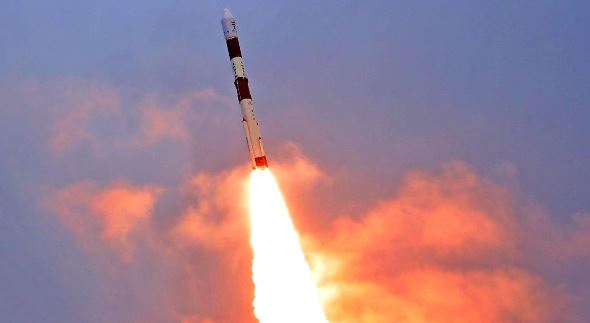
The Indian Space Research Organisation (Isro) is gearing up for its next big mission to launch a customer satellite in an orbit around the planet. The TeLEOS-2 mission will launch onboard Isro's workhorse Polar Satellite Launch Vehicle (PSLV) on its 55th mission to date.
The Singaporean probe is an Earth Observation Satellite, which has been designed to capture round-the-clock, all-weather satellite imagery.
The 750-kilogram satellite, developed by ST Engineering, will provide imagery that could be used for hotspot monitoring and haze management, air crash search and rescue operations, and much more.
"Truly, there is power in imagery," the company said in a Facebook update.
The PSLV is a third-generation launch vehicle developed solely in India and was the first launched from India to be equipped with liquid stages. The rocket is capable of placing multiple payloads into orbit and has been used to launch various satellites into Geosynchronous and Geostationary orbits.
During its last mission, PSLV deployed an Earth Observation Satellite (EOS-06) and eight nano-satellites with a lift-off mass of 321 tonnes into orbit. The Primary satellite (EOS-06) was separated in Orbit-1. Subsequently, orbit change was conducted using two Orbit ChangeThrusters (OCTs) introduced in the Propulsion Bay Ring of the PSLV-C54 Vehicle.
The XL variant of PSLV, which will be used during the C-55 mission, has 6 solid rocket strap-on motors to augment the thrust. The rocket is capable of launching 1,750 kg of payload to Sun-Synchronous Polar Orbits at 600 km altitude and 1,425 kg into Geosynchronous and Geostationary orbits.
(With inputs from agencies)