

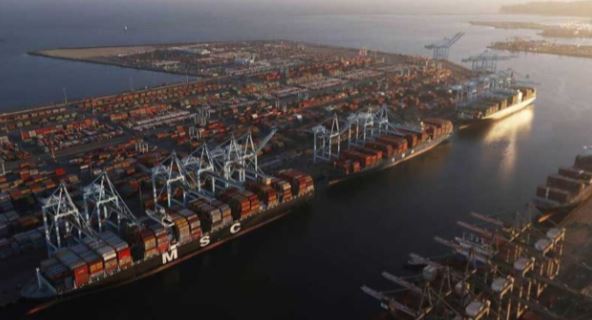
A prominent local leader in Pakistan’s Balochistan province has threatened to close from July 21 the strategic Gwadar Port, a major project under the CPEC that provides China an opening to the Arabian Sea, if the demands agreed by the provincial government, including banning the trawler mafia, are not met, a media report said on Monday.
Sprominent local leader in Pakistan’s Balochistan province has threatened to close from July 21 the strategic Gwadar Port, a major project under the CPEC that provides China an opening to the Arabian Sea, if the demands agreed by the provincial government, including banning the trawler mafia, are not met, a media report said on Monday.
Baloch, who has led rallies in the past, has criticised the government, saying that despite the deployment of various security agencies, hundreds of illegal trawlers were involved in illegal fishing in Balochistan’s waters, depriving local fishermen of their livelihood.
He also claimed that the law and order situation in Makran and Panjgur was deteriorating and in order to control it, the government must remove Frontier Corps from the resource-rich province, the report said.
He said the doors for dialogue are always open, it added.
In December last year, Pakistan and China agreed to use the full potential of the Gwadar Port in Balochistan province, a major project under the China-Pakistan Economic Corridor.
The CPEC, which connects Gwadar Port in Pakistan’s Balochistan with China’s Xinjiang province, is the flagship project of China’s ambitious multi-billion-dollar Belt and Road Initiative (BRI). The CPEC is a collection of infrastructure and other projects under construction throughout Pakistan since 2013. Originally valued at USD 46 billion, the projects were worth USD 62 billion as of 2017.
India has protested to China over the CPEC as it is being laid through Pakistan-occupied Kashmir.
The BRI was launched by Chinese President Xi Jinping when he came to power in 2013. It aims to link Southeast Asia, Central Asia, the Gulf region, Africa and Europe with a network of land and sea routes. The BRI is seen as an attempt by China to further its influence abroad with infrastructure projects funded by Chinese investments all over the world.
(With inputs from agencies)