

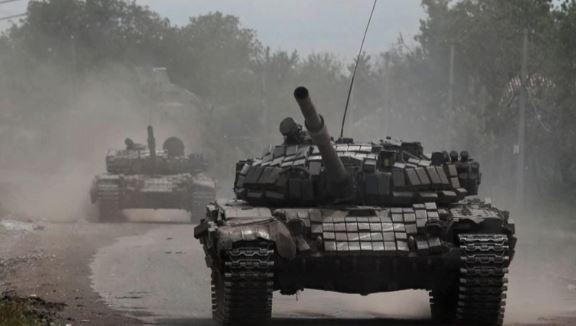
The ongoing Russia-Ukraine crisis has exposed India’s overwhelming dependence on imported weaponry, especially from Russia, and come as a rude shock for India’s military and strategic planners who are grappling with issues such as how the war could affect the country’s military’s readiness, alternatives for sourcing military hardware and speeding up the indigenisation drive to become self-reliant, officials tracking the conflict said on the condition of anonymity.
Each of the three services – the Indian Air Force, navy and army – operate a wide range of Russian-origin weapons and platforms. (Reuters)
“Supply chain hurdles have been an eye-opener. The longer the war lasts, the more pronounced will be its effects. We are not pressing the panic button, but it is critical to keep your eye on the ball,” said one of the officials cited above.
The chief takeaways from the Russia-Ukraine conflict, according to experts, include the urgent need for diversification of weapon purchases, maximum possible indigenisation of spares and sub-systems to keep Russian-origin equipment serviceable, and, most importantly, staying laser-focused on achieving atmanirbharta (self-reliance) to meet India’s growing defence needs.
From fighter jets to air defence weapons and submarines to artillery, India’s dependence on Russia to stay battle-ready is immense and cannot be wished away even though New Delhi has cut it down significantly during the last decade that saw the country make big-ticket military purchases from the United States (US), Israel and France.
Still, Russian-origin weapons and systems form the bedrock of India’s existing capabilities — two-thirds of India’s military equipment is of Russian origin and several key platforms worth billions of dollars are on order. “There are two issues here. Ensuring the serviceability of existing military hardware and planning in a way that caters for delays in ongoing projects,” said a second official.
Russia accounted for 46% of the country’s imports during the last five years even though India made fewer purchases from that country over the last decade. Its weapons exports to India fell 47% between 2012-16 and 2017-21, according to a report published by the Stockholm International Peace Research Institute (Sipri) in March.
Russian-origin equipment held by the three services includes fighter jets, transport planes, helicopters, warships, submarines, tanks, infantry combat vehicles, multi-rocket systems, rifles and even shoulder-fired missiles. Overnight transition to new suppliers is not possible, and military planners will have to figure out what can be substituted and what can’t, the officials said.
Procurements and projects in the works include the S-400 air defence systems, more Sukhoi-30 and MiG-29 fighter jets, frigates, T-90 tanks, a joint production of AK-203 assault rifles and, above all, the lease of a nuclear-powered submarine.
India also sources some military equipment from Ukraine including gas turbines for warships and spares for Antonov-32 transport aircraft.
Neither Russia nor Ukraine can be considered to be reliable suppliers anymore, said former navy chief Admiral Arun Prakash (retd). Russia will prioritise its military requirements and defence complexes in Ukraine have suffered major damage, he said.
Self-reliance appears to be the only solution for India to meet its military requirements, but it cannot be achieved in the short term.
“Atmanirbharta could take 10 to 15 years. But unless we start that process now, we will never achieve that. If you say you are not buying from Russia but importing weapons from the US, France or Israel, that’s not the answer. We have to become atmanirbhar and need to have a master plan in place to achieve that goal,” Prakash added.
The immediate priority is indigenisation of spares and sub-systems and a plan is being worked out to address it with the help of the industry, said a third official. “We were already on the path to self-reliance, but now we have to take bigger and quicker strides in view of the new global developments,” he said.
On lessons to be drawn from the Russia-Ukraine conflict, army chief General Manoj Pande recently said achieving self-reliance in defence was one of the biggest takeaways.
“We are dependent on Russia and Ukraine for some air defence weapons, artillery systems and tanks. Reducing dependence on outside sources is an important lesson. The supply chain of certain systems, spares and ammunition has been impacted to some extient, but we have adequate stocks to last for a reasonable period of time,” Pande told a select group of journalists on May 9.
He said India was identifying alternative supplies from a few friendly foreign countries.
Defence minister Rajnath Singh also made a strong pitch for indigenisation recently citing the Russia-Ukraine crisis.
“Our past experiences have taught us that India cannot depend on imports. Recent conflicts, especially the situation in Ukraine, have told us that not just defence supplies, but commercial contracts are also prone to be affected when it comes to national interests,” Singh said, while delivering the 37th Air Chief Marshal PC Lal Memorial Lecture on May 5.
To be sure, India has imposed a phased ban on the import of 310 different types of weapons and systems during the last two years to boost self-reliance in the defence manufacturing sector.
These include lightweight tanks, naval utility helicopters, artillery guns, missiles, loitering munitions, missile destroyers, ship-borne cruise missiles, light combat aircraft, light transport aircraft, long-range land-attack cruise missiles, basic trainer aircraft, multi-barrel rocket launchers, assault rifles, sniper rifles, specified types of helicopters, next-generation corvettes and airborne early warning and control (AEW&C) systems.
General Pande said another important lesson was that conventional wars were still relevant, and these may not be short and swift. The wars can be prolonged, he said.
“This war has surprised all of us. Preconceived notions about short and swift 21st century wars have gone for a toss. We will have to reassess the nature of future warfare with emphasis on the role of technology,” said Prakash.
Each of the three services – the Indian Air Force, navy and army – operate a wide range of Russian-origin weapons and platforms. IAF is equipped with Sukhoi-30s, MiG-29s and MiG-21 fighter jets, Il-76 and An-32 transport planes, Il-78 mid-air refuellers, and Mi-35 attack helicopters and Mi-17 utility choppers.
The navy’s sole aircraft carrier INS Vikramaditya and the MiG-29K fighter jets it operates are from Russia, and so are its Kilo-class submarines, Rajput-class destroyers and Talwar-class frigates.
The army operates T-90 and T-72 tanks, BMP-II infantry combat vehicles, Smerch and Grad multi-rocket systems and several surface-to-air missile systems.
“We have exploited the Russian-origin equipment to the hilt. But now we need to go in for large-scale indigenisation so that we are no longer dependent on external sources, including Russia. That’s what strategic autonomy is all about,” said military affairs expert Lieutenant General Vinod Bhatia (retd).
(With inputs from agencies)