

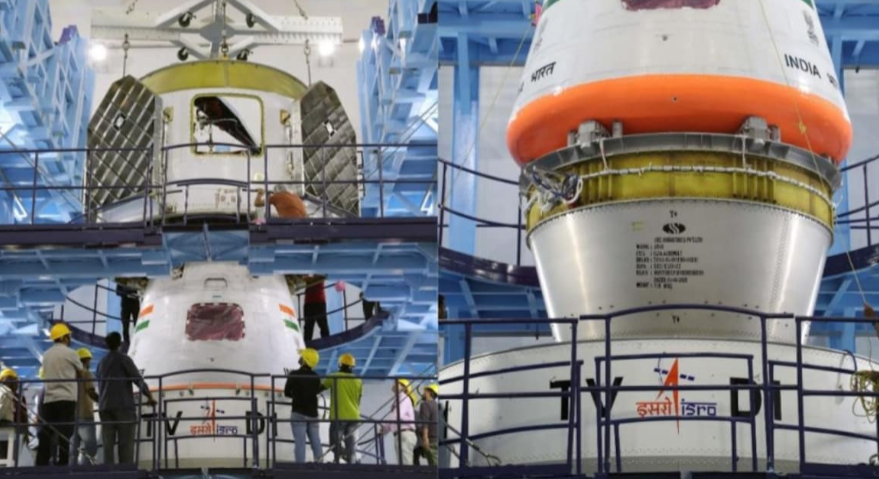
The 35-meter-tall Test Vehicle rocket stands ready at the First Launchpad of India's Satish Dhawan Space Centre, Sriharikota, Andhra Pradesh. The 12-hour 30-minute countdown for the launch began at 7:30 pm Friday (Oct 20), media has learnt. At 8 am IST, Saturday, as this countdown ends, the 44-ton vehicle is expected to blast off on a very unique mission.
Unlike orbital-class rockets, this one is not meant to take satellites to space. Instead, it will be used to test a crucial ejection system(known as Crew Escape System) that is meant to save astronauts, in case of a mid-flight rocket failure.
The countdown is the time period in the final run-up to the launch, when the health checks of the rocket and associated systems are conducted. Liquid fuels are filled into the rocket's tanks and various parameters are monitored, in preparation for lift-off. Each mission has a unique countdown time, depending on its complexities, and mission profile and type of rocket being used.
The mission abbreviation 'TV-D1' denotes Test Vehicle Demonstration 1. Perched atop the test vehicle is a crew-carrying capsule, known as a Crew module. During the Indian astronaut mission Gaganyaan (expected to take flight in 2025), the Crew module will serve as the home and office of the astronauts, as they travel to space and back. The Crew module being used in Saturday's mission measures and weighs the same as the actual one. However, it doesn't contain pressurization systems(meant to maintain earth-like atmospheric conditions and other technologies that the final version will feature.
Typical spacefaring rockets travel at least 500 km above the earth's surface into an orbit around the home planet. However, TV-D1 would be launched to an altitude that's a little more than that of passenger airliners. 61 seconds from lift-off, the vehicle would reach an altitude of 11.9 km and a speed of Mach1.2(1480kmph) and that's when the rocket would shut down, as pre-programmed.
Immediately, the Crew escape system would be triggered and the top portion of the rocket comprising the escape system and the crew module would eject itself higher and farther away from the rocket. They would travel a couple of kilometres higher away from the rocket. 90 seconds after lift-off, at around 17kms altitude, the crew escape system and crew module would separate. While the rocket and the crew escape system free-fall into the sea, the crew module uses multiple parachutes to gradually descend and splash down, almost 10kms away from the spaceport's shore. From lift-off to splashdown, this mission is expected to take less than nine minutes.
Ejecting the 4.5-ton crew module during flight is an extremely sophisticated process. The engineers working on this project would want to test their rocket, crew module and ejection systems at different altitudes and Mach numbers (travel speeds). This would offer them more confidence about the reliability and robustness of the systems that are meant to save astronauts when the rocket faces a catastrophe.
This process can be compared to how a fighter pilot pulls the ejection handle as a last resort when his/her jet faces an imminent crash/failure. In the jet, the pilot has control to pull the ejection handle, However, given how fast rockets travel and how fast things can go wrong, computer programmes are used to issue the eject/abort command, given how rapidly it must be done.
After the crew module splashes down in the Bay of Bengal, Indian Navy ships that are waiting within a safe distance would approach the module and with the assistance of expert swimmers, secure the crew module and lift it onto the ship using the on-board crane. Thereafter, it will be secured onboard the ship and then taken to the nearest port(Chennai) and handed back again to ISRO.
As the name suggests, TV-D1 is the first of at least four similar tests. Lessons learnt from each test would be applied in the subsequent ones and hardware, software and system changes would be made, to develop the best possible crew escape system. Apart from flight tests, there are several other ground tests also being performed in the run-up to the Gaganyaan astronaut mission. During such testing, ISRO also tries out different types of hardware, made using different materials and different manufacturing processes. This helps zero in on the most-suited version.
By external appearance, Test Vehicle might seem like an all-new rocket. However, it is derived from the L40 booster that is used on the GSLV(formerly GSLV Mk2) rocket. It is a liquid-fuelled rocket stage that is being used for this test, Instead of using a large and expensive rocket for this test, ISRO has re-purposed and modified an existing system for low-cost and easy execution of multiple tests. This Test Vehicle is based on the workhorse Vikas engine that powers the PSLV and GSLV series of rockets. Instead of mounting satellites atop the Test vehicle, the crew module and crew escape system have been mounted, thereby giving the vehicle an all-new appearance.
(With inputs from agencies)