

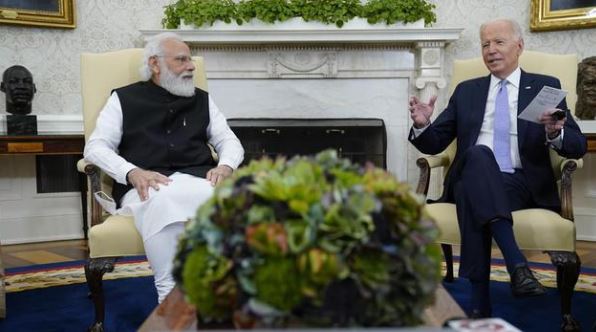
Excitement is off the charts for Prime Minister Narendra Modi’s maiden state visit to the United States. US officials say it will be a “springboard” to touch new horizons, set “new benchmarks” in defence-industrial cooperation and propel the relationship into “escape velocity”. They say they are playing the long game with India.
Key members of President Joe Biden’s cabinet have spoken with unusual clarity and enthusiasm in recent days, stressing the path-breaking initiatives they have launched to break old taboos and overcome the hesitation that still exists within the US bureaucracy. The White House is calling the shots and projecting Modi's visit as the cement that will bind the two countries and “consecrate” the relationship -- to use the words of Kurt Campbell, the White House coordinator for the Indo-Pacific. Defence Secretary Lloyd Austin said the two countries were at a “transformative moment” while on a visit to New Delhi earlier this month.
The flurry of reciprocal visits at senior levels is an important measure of intense engagement. It indicates a strong commitment on both sides to align, coordinate and complement each other in the face of unique challenges facing the world today. The year started with the two national security advisors -- Ajit Doval and Jake Sullivan -- inaugurating the Initiative on Critical and Emerging Technologies or iCET as the overall framework across domains from defence cooperation to strategic trade to building resilient supply chains to collaboration in space to education.
But at the other end of Pennsylvania Avenue is Capitol Hill, where Modi faces different expectations. His address to a joint session of Congress will be scrutinised for India’s stand on Russia and China. Two key senators and long-time friends of India criticised New Delhi on Tuesday for taking “a pass” on the Ukraine war while speaking at the Ideas Summit organised by the US-India Business Council.
Senator Mark Warner, a Democrat and co-chair of the India Caucus, said now that India had arrived as “a truly great and one of the most important nations in the world, they can no longer take a pass” on major issues of the day like Russia’s war on Ukraine. Senator John Cornyn, the Republican co-chair, sitting beside him was also critical. He said "it was a little bit disappointing that when Russia invaded Ukraine, India took a pass". Cornyn, however, qualified his remarks by acknowledging India’s “dependency on Russian weaponry” and 50 years of history between the two countries.
Warner also said he wanted the Prime Minister to address what many have called the shrinking space for dissent in India. He would like to see a “re-commitment” to the rule of law, a fair political process and a free press from Modi. He said he was “troubled” by some of the Indian government reactions that he deemed “a bit over the top” in an apparent reference to cases against journalists, the disqualification of Congress party leader Rahul Gandhi from Parliament and violence against minorities. Warner also said “India’s time has arrived” and praised India for standing up to China on the border.
Senator Mark Warner, a Democrat and co-chair of the India Caucus, said now that India had arrived as “a truly great and one of the most important nations in the world, they can no longer take a pass” on major issues of the day like Russia’s war on Ukraine. Senator John Cornyn, the Republican co-chair, sitting beside him was also critical. He said "it was a little bit disappointing that when Russia invaded Ukraine, India took a pass". Cornyn, however, qualified his remarks by acknowledging India’s “dependency on Russian weaponry” and 50 years of history between the two countries.
Warner also said he wanted the Prime Minister to address what many have called the shrinking space for dissent in India. He would like to see a “re-commitment” to the rule of law, a fair political process and a free press from Modi. He said he was “troubled” by some of the Indian government reactions that he deemed “a bit over the top” in an apparent reference to cases against journalists, the disqualification of Congress party leader Rahul Gandhi from Parliament and violence against minorities. Warner also said “India’s time has arrived” and praised India for standing up to China on the border.
In terms of the substance of the visit, administration officials have promised a bagful of “deliverables” and happy optics. The deliverables will indeed be significant, including an agreement to co-produce the General Electric (GE) jet engines in India starting with assembly and moving to actual production of parts and systems. Sources say that the technology transfer will be around 60 per cent and in stages. It is a hugely significant development given that talks stalled in the past over tech transfer issues. Both sides have since had an overdose of realism because of the “C” factor.
An equally important breakthrough could come in the field of semiconductors, where India is pushing for US companies to help create an ecosystem for assembling, testing and packaging. What’s different is that US officials and members of Congress have lent their voices to urge the private sector to think about India as an alternative to China. In the past, officials have countered requests to urge US corporates to invest in India with the plea: we can’t tell the private sector what to do. Well, now they are telling them to have a Plan B besides China.
(With inputs from agencies)