

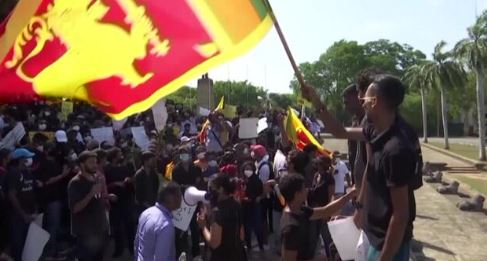
Sri Lanka’s parliament convened on Tuesday for the first time after a state of emergency was imposed. The country of 22 million people has been suffering from a shortage of food, fuel, and prolonged power cuts lasting up to 13 hours, triggered by a lack of foreign exchange that has stalled imports.
Opposition parties and even members of Rajapaksa’s ruling alliance rejected the move for a unity government, setting the stage for a test of strength in parliament.
Police used tear gas to disperse hundreds of protesters who gathered outside Prime Minister Mahinda Rajapaksa’s private residence in Tangalle, in southern Sri Lanka. Mahinda, the president’s elder brother, was away at the time in Colombo, the country’s commercial capital, where peaceful protests continued into the night.
“Protesters broke through two barricades that had been placed near the residence and police had to use tear gas to move the protesters away,” police spokesperson Nihal Thalduwa said. Crowds also gathered outside the homes of six lawmakers and the party office of a former state minister spread across the country, he said.
After many protesters demanded the total ouster of the Rajapaksas, the president’s media office said in a statement that four new ministers had been appointed “to ensure parliament and other tasks can be conducted in a lawful manner until a full Cabinet can be sworn in.”
The president’s nephew resigned as sports minister in the government that was disbanded while the Central Bank of Sri Lanka (CBSL) governor offered to quit. The CBSL delayed its monetary policy announcement scheduled for Tuesday.
Former CBSL official P. Nandalal Weerasinghe said on Monday that he had accepted an offer from Rajapaksa to become the central bank’s next governor.
“The president called me and made the offer, and I have accepted,” Weerasinghe told Reuters.
The president’s media office said Justice Minister Ali Sabry was named finance minister, replacing Basil Rajapaksa, the president’s younger brother, who was due to visit Washington this month for talks with the International Monetary Fund (IMF) on a loan programme. Ali Sabry, however, resigned from the post on Tuesday, within 24 hours of his appointment.
Ministers of foreign affairs, education and highways will keep their positions. “The president invites all political parties representing in the parliament to come together to accept ministerial portfolios in order to find solutions to this national crisis,” the media office said.
Udaya Gammanpila, chief of one of the 11 political parties comprising the ruling coalition, called the new Cabinet “old wine in a new bottle”.
“Our demand is for an all-party interim government to restore essential services and to hold a parliamentary election,” Gammanpila, of the Pivithuru Hela Urumaya party, wrote on Twitter. “People should decide their next leaders, not anybody else.”
Sajith Premadasa, leader of Sri Lanka’s main opposition, rejected Rajapaksa’s offer to form a unity government. “This is a crooked and corrupt government that has brought the people to their knees. The demand of the people is a government like this must go home immediately,” he said in a video statement.
(With inputs from agencies)