

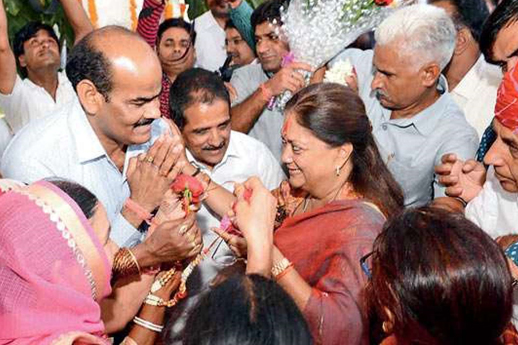
New Delhi: The residents of Ramdevra in Jaisalmer district, be it farmers, traders or priests of the temple, have only one expectation from the chief minister’s public meeting that will follow the temple visit. They want Raje to announce that ‘meetha paani’ (potable water) will soon be available in the village that is dependent on groundwater that is hard and unfit for consumption.
As one walks through the narrow road leading to Baba Ramdev temple in Ramdevra village, about 12 km from Pokhran, there are subtle signs that chief minister Vasundhara Raje will be visiting the place on Friday, soon after launching the second leg of Gaurav Yatra from Jaisalmer.
The road has been patched up and demarcated, and small-time traders offering a variety of wares at the makeshift market on both sides of the road have been warned against encroachment.
The residents of Ramdevra, be it farmers, traders or priests of the temple, have only one expectation from the chief minister’s public meeting that will follow the temple visit. They want Raje to announce that ‘meetha paani’ (potable water) will soon be available in the village that is dependent on groundwater that is hard and unfit for consumption.
“The pipelines have been laid, but there is no water supply. We want the chief minister to announce that potable water will soon be available in our village,” said Nathuram Bishnoi, a farmer, between sips of tea at Baba Ramdev Dhaba, a stone’s throw away from the temple.
A priest at the temple, Pyarelal Sharma, echoed his sentiment. “Bas meetha paani mil jaye, baki sab kuch bijli, sadak to hai (we only want potable water, rest including electricity and road are already there).
The temple marks eternal resting place of Baba Ramdev, a saint of the 14th century who is regarded by Hindus as the incarnation of Lord Vishnu, while Muslims venerate him as Ramshah Pir. Maharaja Ganga Singh of Bikaner constructed a temple around the samadhi in 1931. The complex also houses the tombs of five Muslim Pirs.
According to the 2011 census, the village has a population of 1499, but during the 40-day fair in August and September, the population swells to more than 10,000 when hundreds of devotees throng the temple from all over the country.