

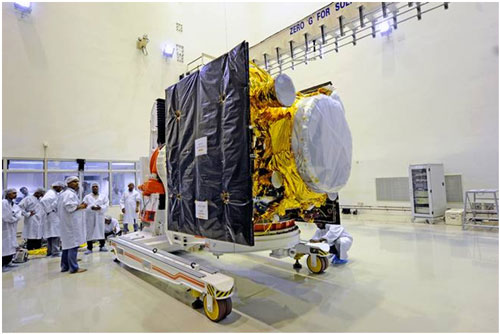
\New Delhi:Indian Space Research Organisation (Isro) has developed an atomic clock that will be used in navigation satellites to measure precise location data. This is a very significant development as far as space research is concerned. The space agency currently imports atomic clocks from European aerospace manufacturer Astrium for its navigation satellites.
TapanMisra, director of Ahmedabad-based Space Applications Centre (SAC), said, “SAC has developed an indigenous atomic clock and this clock is currently undergoing a series of qualification tests. Once it successfully clears all tests, the desi atomic clock will be used in an experimental navigation satellite to test its accuracy and durability in space.”
The SAC director said, “With the development of the desi atomic clock, Isro has become one of the few space organisations in the world which have gained the capability to develop this highly sophisticated technology. We don't know the design and technology of the imported atomic clock. But the desi clock has been developed based on our designs and specifications. This clock is as good as the imported one. We are hopeful that it will easily work for more than five years.”
All seven navigation satellites launched earlier as part of Indian Regional Navigation Satellite System (IRNSS) or NaVIC have three imported Rubdium atomic clocks each.
On functioning of these atomic clocks, TapanMisra said, “Atomic clocks in all the seven satellites launched earlier are synchronised. The time difference between the atomic clocks of different satellites positioned at different orbits are used to measure the accurate positioning of a navigation receiver or an object on the Earth.
If an atomic clock malfunctions, the time difference calculated between it and other clocks is not accurate which, in turn, gives inaccurate positioning of an object. Besides atomic clocks, a navigation satellite also has crystal clocks but they are not accurate as atomic clocks. Therefore, if three atomic clocks of a satellite show error, we need to launch a back-up satellite with new atomic clocks."