

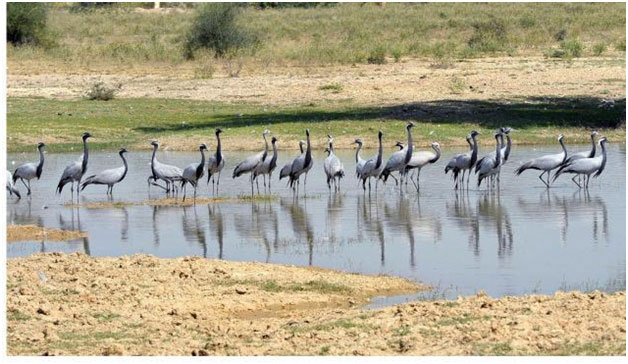
New Delhi: A study has found that water bodies have decreased by a steep 40% in the national capital region (NCR) as a result of rapid urbanisation between 1972 and 2014, when the region saw a 17-fold rise in urban built-up areas.
At certain places, the complete transformation into an urban environment has led to an increase of 3 to 5 degrees in land surface temperature and 2 to 4 degrees in air temperature during this period, the study by the Centre for Atmospheric Sciences at IIT Delhi revealed.
The study published in Springer Nature's Theoretical and Applied Climatology raises serious questions on the way urban planning was conducted in satellite town. The spatial coverage of urbanised areas, where temperature rise was seen, grew with every decade during the 42-year periods around Delhi.
The assessments were done by tracking the land use change in NCR for five years representative of 5 decades - 1972, 1981, 1993, 2003 and 2014 - using satellite images. The impact on meteorology was examined using a weather research and forecasting (WRF) model.
The study drew the example of Sariska National Park in Alwar district to illustrate the way forests were degraded in the region. Sariska saw a massive reduction in green areas over the years. From 240 sq km in 1972, its expanse reduced to 160 sq km in 2014, a decrease of about 33% of forest cover. "The dense tree canopies are replaced by shrub lands and sparse vegetation," the report states.
Increase in land surface temperature has also led to a reduction in diurnal temperature range (difference between daily maximum and minimum temperature) by about 2 degrees in some areas while an increase of 1.5 degrees in night temperature was seen in some places.
"Urbanisation effects increases adverse effects to human health and welfare by increasing temperatures, prolonged period of higher temperatures during a day resulting into increased thermal stress, increased time period window for diseases such as malaria and increased cooling energy demand, formation of secondary pollutants such as ozone etc," the study concluded.