

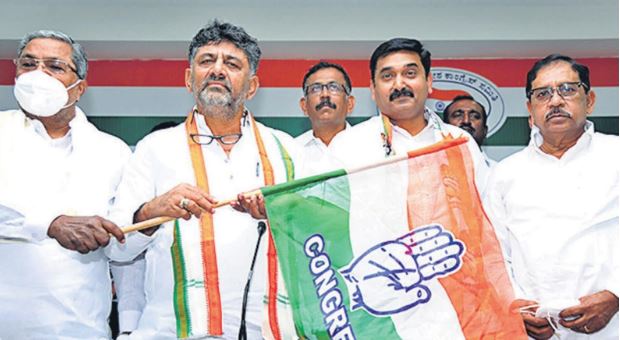
With an eye on the 2023 assembly elections, the state Congress is making key appointments within the outfit while attempting to reach out to communities and sections that are not considered part of its support-base.
The recent appointments include UT Khader, a Muslim, as the deputy leader of the opposition and BK Hari Prasad, a Billava, as the head of the Congress party in the upper house of the state legislature.
MB Patil, who was named the campaign chief for the Karnataka Pradesh Congress Committee (KPCC) is from the dominant Lingayat community, believed to be the single-largest caste group in the state.
“This move (caste and religious representation) will not cut much ice. It is just an effort by the politicos to portray themselves as leaders of the community,” said a Bengaluru-based political analyst, requesting not to be named.
State Congress chief DK Shivakumar is from the dominant Vokkaliga community while the leader of the opposition, Siddaramaiah, is a Kuruba.
Shivakumar tried to cash in on the Vokkaliga vote with the foot march for Mekedatu that would propel him or at least put him in strong contention for the top job if the Congress comes to power on its own in 2023.
“It is the ideology of the Congress to give representation to all the communities. There may be some electoral benefits but it is not all about that,” claimed party spokesperson Ramesh Babu.
“It is about following the party ideology and generally also the party makes appointments 14-15 months before the elections,” Babu said.
In recent times, the Lingayats are known to have sided with the Bharatiya Janata Party (BJP) while the Vokkaligas, who have decisive numbers across several parts of the old Mysuru region, back the Janata Dal (Secular) or JD(S). The Congress has depended largely on the support base from backward classes, minorities and other marginalised communities.However, both the BJP and the Congress are aware that they would have to reach beyond their traditional turf to get a majority on their own.
The BJP has been trying to gain a foothold in the old Mysuru region on its own, failing which, it can rely on the JD(S) to keep the Congress out. But the infighting within both national parties have kept them occupied at their own levels rather than capitalise on the rival’s problems.
While the 2015 Socio-Economic and Education Survey, better known as the caste-census, threatens to challenge the dominant caste narrative here, Siddaramaiah is keen to tap on it to consolidate his AHINDA (Kannada acronym for minorities, backward classes and Dalits) support base. Even though this might dent the vote base of dominant caste groups and its political leaders, including those from within the Congress who depend more on community than on ideology to win elections.
The BJP too has seen a divide over caste-based support. “BS Yediyurappa was forced to step down as chief minister last July as he did not fit the BJP’s larger plans of fighting on the Hindutva platform and moving away from the caste-based politics which has shaped his career so far,” said a political expert, pleading anonymity.
Yediyurappa will, however, be key to get the Lingayat community votes, said the expert.
The state BJP has been taking a hardline approach, which the analysts said was the new chief minister (CM) Basavaraj Bommai trying to appease the right wing.
Under Bommai, the state government came up with anti-conversion law that is yet to be passed by the upper house. The Bill is likely to be presented before the council in the upcoming joint session of the legislature, scheduled to commence from February 14.
Professor Chambi Puranik, a Bengaluru-based political commentator said that though Bommai may sail through till the next elections, the party would still need Yediyurappa. “Bommai is still not a strong CM. He can take the party to the next election but winning will depend on Yediyurappa,” he said.
Under Bommai, the state government came up with anti-conversion law that is yet to be passed by the upper house
(With inputs from agencies)