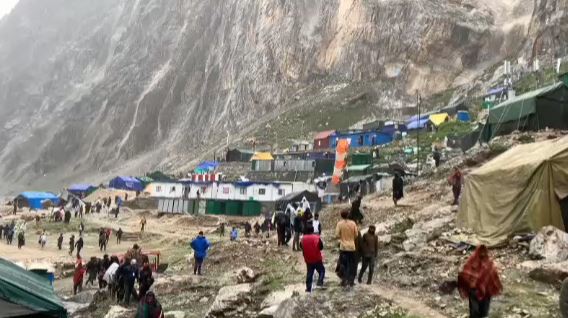
Cloudburst is the reason that has been attributed as a cause of death of at least 13 Yatris in a flash flood near the Amarnath cave shrine in Jammu and Kashmir on Friday. But was it indeed a cloudburst? J&K DGP Dilbag Singh said 13 pilgrims were killed in the cloudburst that hit the area at around 5.30 pm. However, the India Meteorological Department (IMD) said that it was not a cloudburst.
Every year, IMD releases a special weather advisory for Amarnath Yatra. The general, daily forecast for the district on Friday was of yellow alert (means, keep watch). Even the evening forecast, up on the Amarnath Yatra forecast website at 4.07 pm, said, “Partly cloudy sky with possibility of very light rain” for all along the route from both Pahalgam side and Baltal side. There was no accompanying warning.
As per the data from the automatic weather station (AWS) at the holy cave, there was no rainfall from 8:30 am till 4:30 pm.
“Then there was just 3 mm rainfall between 4:30 pm and 5:30 pm. However, between 5:30 pm and 6:30 pm there was 28 mm rainfall,” said an IMD scientist.
As per IMD criterion, only if there is 100 mm rainfall in one hour then it is termed as cloudburst.
Then what exactly happened? According to eyewitness accounts and the multiple videos going viral on social media, a stream between two mountain faces — barely 200-300 metres away from the cave entry — brought down heavy rubble along with large quantity of water. Clearly, it was the result of rainfall behind the holy cave.
(With inputs from agencies)