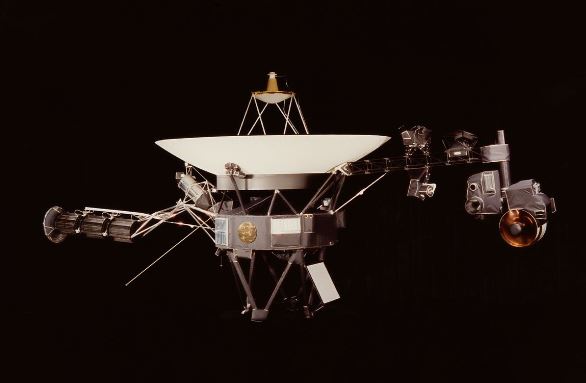
NASA’s Voyager-1 is currently floating in interstellar space, roughly 23.3 billion kilometres far from our planet Earth. Launched 45 years ago, the Voyager-1 became the first spacecraft to exit the solar system in 2013. Even after almost half a decade, scientists are able to detect signals and receive data from the spacecraft, thanks to the Attitude Articulation and Control System (AACS). But recently, the data received baffled NASA scientists for the deceptive nature of it. The telemetry data that is being received on Earth is mysteriously different from the on-board condition of the spacecraft.
AACS, among other tasks, also has the responsibility to align the high-gain antenna at an angle precisely in cohesion with Earth. This plays a major role in sending telemetry data back home. Although the AACS is working completely fine, and the signals received is one of the pieces of evidence to it, the data is invalid and erroneous. The data, as per NASA’s report, appears to be randomly generated and paints a picture of a state that AACS could not possibly be in. Talking about the glitch, Suzanne Dodd, project manager for Voyager 1 and Voyager 2, Jet Propulsion Laboratory, in a statement, said, “A mystery like this is sort of par for the course at this stage of the Voyager mission.”
Dodd explained that the spacecraft has performed far beyond what was planned for the mission. In addition, the environment that the Voyager-1 has entered is a high-radiation zone where “no spacecraft have flown in before.” “So, there are some big challenges for the engineering team. But I think if there is a way to solve this issue with the AACS, our team will find it,” Dodd said. The spacecraft launched in 1977 has, since then, provided information about interstellar space, giving depth to the understanding of humans about the world outside the Earth, and even the solar system.
(With inputs from agencies)