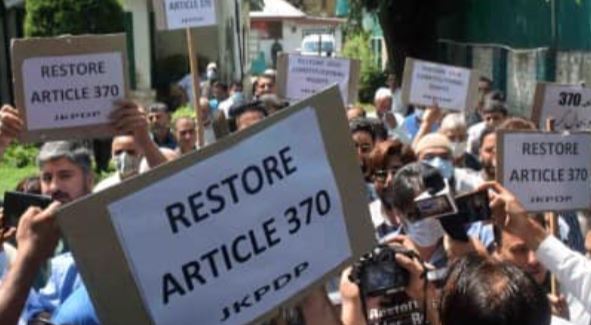
With the Centre making it clear that it has “absolutely no intent” to touch the special provisions of the Constitution concerning states in the Northeast and other parts, the Supreme Court Wednesday refused to be drawn into a debate over them and disposed of an intervention application which sought to raise apprehensions.
A five-judge bench, presided by Chief Justice of India D Y Chandrachud, was hearing petitions challenging the Centre's 2019 move to abrogate Article 370 in Jammu and Kashmir and bifurcate the erstwhile state into two Union territories.
“The applicant...has urged that apart from the provisions which are contained in Part XXI of the Constitution pertaining to Jammu and Kashmir, there are special provisions in the Constitution governing the northeast in the same part. Hence it has been submitted that the interpretation which would be placed by this court on Article 370 may possibly impact upon the other provisions," the bench, also comprising Justices Sanjay Kishan Kaul, Sanjiv Khanna, B R Gavai, and Surya Kant, said in its order.
"The Solicitor General submitted on the specific instructions of the Union government that the Union government has absolutely no intent to affect any of the special provisions applicable to the northeast and to any other part of India. The reference to the Constitution bench was confined to the provisions of Article 370 of the Constitution. There is no commonality of interest between the issues which are sought to be addressed by the intervenor and the issues which have been raised in the reference to this Constitution bench. In any event, the statement which has been made on behalf of the Union government would allay any apprehension in that regard. We, therefore, close the intervention application which shall stand disposed of,” the bench added.
The bench said this following an intervention by Solicitor General Tushar Mehta as advocate Manish Tewari sought to draw the attention of the court to Article 371, which deals with the special provisions, and said the court’s decision on Article 370 will have implications on Article 371.
Tewari, who appeared for a former Arunachal Pradesh minister, said, “The underlying principle of autonomy in Articles 370 and 371 is more or less the same. Therefore, what Your Lordships will hold in this matter, either way, will have implications on Article 371...”.
Intervening, the SG said, “I have instructions to say this. We have to be very very responsible in assisting your lordships and we must understand the difference between temporary provision, which is Article 370, and special provisions with regard to other states, including the Northeast. The central government has no intention to touch any part which gives special provisions to the Northeast and other regions”.
He added that he was interrupting as Tewari's “submission would have a very potential mischief” and urged the court to confine the proceedings to Article 370.
Tewari said he “was not referring to the current central government. I was referring to the principal at stake”. The court was, however, not inclined to proceed with the issue any further as it disposed of the application.
(With inputs from agencies)