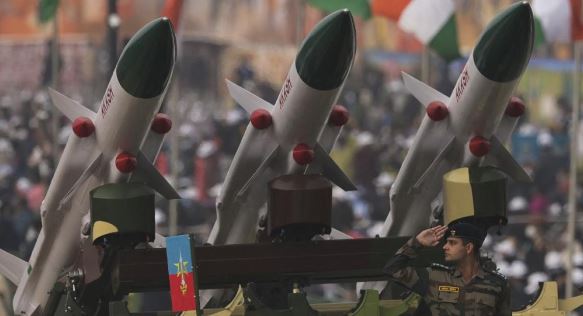
A belligerent China and the ongoing Russia-Ukraine conflict have pushed total global defence expenditure to record levels in 2022, jumping by 3.7 per cent to reach an unprecedented high of $ 2,240 billion, the Stockholm International Peace Research Institute said in a new report.
With an arms budget of $81.4 billion, India retains its place as one of the world's top five military spenders. The United States leads the pack with an expenditure of $877 billion, and China a distant second place with $292 billion.
Russia is in third place with a defence budget of $86.4 billion – less than a tenth of arch rival the United States. Riyadh rounds out the top five with $75 billion in spending.
Incidentally, the three largest spenders in 2022— the US, China and Russia — accounted for 56 per cent of the world's military spending. Moreover, at a time of heightened tensions at the Himalayan border, Beijing's expenditure was three and half times higher than that of New Delhi's.
"India raised its defence spending by 6 per cent from 2021 and 47 per cent from 2013 consequent to the border tensions with China and Pakistan. Its expenditure on capital outlays that funds equipment upgrades for the armed forces and to the military infrastructure along its disputed border with China, amounted to 23 per cent of total military spending in 2022," the report stated.
On the other hand, China has boosted its military expenditure for 28 consecutive years. The one-party nation's defence budget has surged 63 per cent since 2013 and the outlay in 2022 being 4.2 per cent more than in 2021.
India has been raising its military spending year-on-year as it focuses on three objectives – modernising the tri-services, bolstering troops deployed along the borders with Pakistan and China, and shoring up domestic defence manufacturing.
This year, Finance Minister Nirmala Sitharaman allocated Rs 1.63 trillion for defence capital outlays – an expenditure that would include new weapons, aircraft, warships and other military hardware, as she unveiled nearly $550 billion of total federal spending in the annual budget for 2023-24 starting in April.
With the government's 'atmanirbhar' push, defence production has also started picking up in the country. India now has an impressive stockpile of indigenously made, lethal ballistic missiles that act as deterrence.
A core component of India's "rocket force", Pralay is the country's first tactical quasi-ballistic missile with a range of 150-500 kilometres. It can carry conventional warheads weighing 500-1,000 kg.
Agni-V is an ingeniously built advanced surface-to-surface ICBM that can strike targets half a world away with a very high degree of accuracy. It is capable of delivering a 1.5 tonne nuclear warhead.
Used in naval point and area defence, Barak-8 is all weather missile system which can engage sea skimming to high altitude targets up to a distance of 150 km. It can intercept aircraft, low-flying anti-ship and cruise missiles, and stealthy targets.
An Indo-Russian venture, the Brahmos cruise missile packs a supersonic punch. With a proven range of up to 280 km, which was further enhanced to 450 km during recent tests, BrahMos missiles can reach speeds of up to Mach 3 and take out deep underground bunkers of the enemy.
Developed by the DRDO, the VL-SRSAM is a surface to air missile that can be used to target an enemy ship or missile flying at low altitude in a range of 25-30 km. It flies at Mach 4 speeds, twice that of the Barak-8 missile.
Named after the bow of Lord Shiva, the Pinaka rocket system fires 12 projectiles in 44 seconds. Its range is 7 to 90 kilometres. High Explosive Fragmentation (HMX), cluster bombs, anti-personnel, anti-tank and landmine weapons can be installed on top of the Pinaka rocket.
A double-tiered anti-ballistic missile system consisting of two land and sea-based interceptor missiles, namely the Prithvi Air Defence (PAD) missile for high altitude interception, and the Advanced Air Defence (AAD) Missile for lower altitude interception. The two-tiered shield should be able to intercept any incoming missile launched 5,000 kilometres away.
(With inputs from agencies)