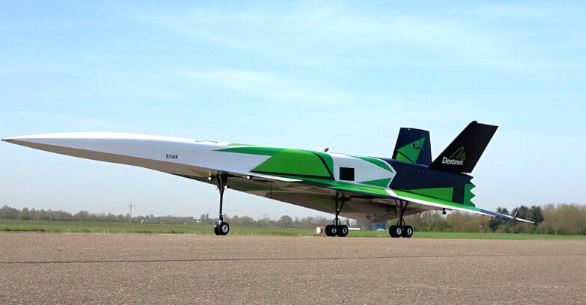
Destinus, the Swiss start-up founded by Mikhail Kokorich in 2021, aims to build a hypersonic aircraft powered by liquid hydrogen by 2030. The Spanish Ministry of Science has allocated grants totalling 27 million euros to support the idea. The first tranche of 12 million will be used to create an infrastructure in the Madrid area for the development of the propeller, while the remaining 15 will allow for further research into hydrogen engines, which present several complications.
The Spanish ministry's investment in liquid hydrogen technologies slows down the initial mistrust of the new technology. The Italian company Sea has announced that it will build a plant for the production of liquid hydrogen by 2024, which will primarily serve the airport's ground vehicles. The bet on the future of aviation based on liquid hydrogen is serious.
Destinus' Head of Product Development, Davide Bonetti, comments positively on the investment by the Spanish Ministry of Science, emphasising the importance of the funding to accelerate the startup's technological innovation and increase its global competitiveness.
Destinus has produced two scale prototypes Jungfrau and Eiger. The start-up plans to move to a test plane by the end of 2023, to test supersonic flight and hydrogen propulsion, the key elements of the project. However, there are still many tests needed to fine-tune the technology.
The Destinus project aims to develop a 25-seat aircraft that can fly from Europe to Australia in four hours and from London to New York in 90 minutes, but the challenges are complex. Liquid hydrogen requires an equivalent load capacity on board compared to normal jet fuels, and costs 20 times more than kerosene. There are doubts about the race to ultra speed and the energy supply to reach hypersonic speed. Undoubtedly, the project is ambitious and opens up a lot of discussion.
(With inputs from agencies)