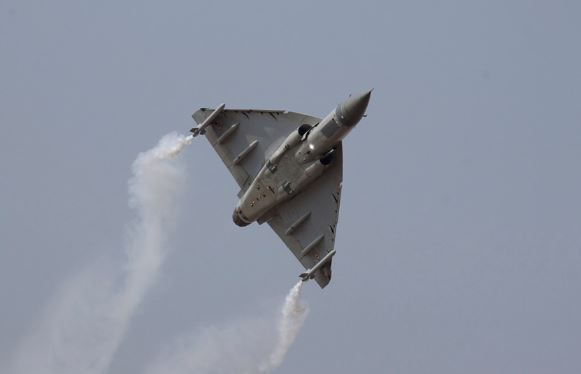
India is among a handful of nations in the world that is capable of making a fighter jet and has made 2 fighter jets till date. First was the HAL Marut and the second is the IAF Tejas LCA, the only active India-made fighter jet with the Indian Air Force. The IAF Tejas, in many ways, is a stepping stone for the government's 'Make-in-India' campaign and also among the most advanced home-made fighter jets, although it's a Gen 4 fighter jet, as against the Dassault Rafale, the only 4.5 Gen aircraft with the Indian Air Force. Tejas is a single engine multi-role supersonic fighter aircraft that will replace the ageing Soviet-era MiG-21 Bison jets.
On the other hand, the JF-17 Thunder is a fighter jet jointky developed by China and Pakistan. The JF-17 serves with the Pakistan Air Force, who considers them a home-made fighter jet, even though its co-developed with China. The Pakistani JF-17 Thunder is updated time and again and competes against the Indian Air Force's HAL-Tejas LCA as an advanced indigeous fighter jet. Here's how the Indian Air Force's Tejas LCA and Pakistan Air Force's JF-17 Thunder stack against each other:
Tejas LCA: Back in the 1980s, HAL started the Light Combat Aircraft (LCA) programme to replace the ageing Soviet sourced MiG-21. With India's former Prime Minister giving the LCA its name - Tejas - the indigenously built fighter aircraft was inducted in the Indian Air Force with the IAF placing a 20 jet order initially and the first Tejas Squadron was formed in 2016 called the Flying Daggers. Till now IAF has placed an order of 40 Tejas Mk 1, including 32 single-seat aircraft and eight twin-seat trainers. IAF has also formalized procurement of a further 83 fighters in Mk 1A configuration.
The HAL Tejas is fully indigenous made fighter jet, while the JF-17 is a Pakistan-China jointly developed jet. The HAL Tejas is both faster, lighter than the JF-17 and has a more powerful engine too. The payload carrying capacity is more than the JF-17 too. The HAL Tejas is also modified to use for Naval forces and can take-off and do arrested landing on aircraft carriers, as recently demonstrated by HAL and Indian Navy.
(With inputs from agencies)