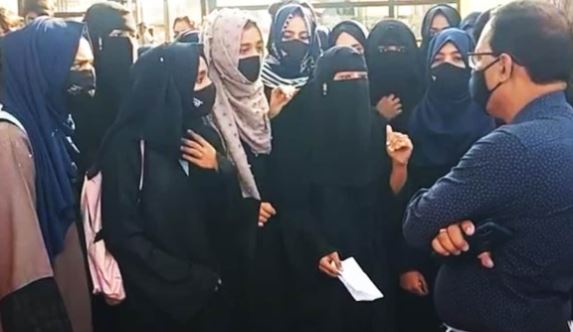
The Karnataka high court cannot be faulted for ruling on whether the hijab formed an essential religious practice in Islam or not since the petitioners decided to assert their religious right, the Supreme Court observed on Monday as it continued hearing the Karnataka hijab row cases.
The bench of justices Hemant Gupta and Sudhanshu Dhulia added that interpretation of Quran or its verses became indispensable for the high court after the petitioners claimed that the wearing of hijab must be protected as an essential religious practice – an argument rejected by the high court in its March 15 judgment. The high court held that wearing of hijab by Muslim women does not form a part of essential religious practice in Islam, adding the Karnataka government was empowered in law to prescribe uniforms for educational institutions.
“You went to the court and said that this is an essential religious practice. What option does the high court have but to examine this argument? The high court then has to give its decision one way or the other. Now you say, the high court should not have done this,” the bench told senior counsel Yusuf Muchhala, who was appearing for one of the petitioners in the case.
At this, Muchhala replied that the court should have chosen to steer clear of the issue. “It is only judicial wisdom to not touch a field in which they have no expertise. The high court, when encountered with the essential religious practcie, should have said ‘hands off’, that we cannot look into this,” he added.
The bench, however, retorted: “Mr Muchhala, are you not contradicting yourself? On one hand, you are saying questions of essential religious practices should be referred to a a larger bench but on the other, you are saying no court should look into it.”
The senior counsel responded that he was seeking reference of issues related to interpretation of Constitutional rights on religion and that his argument was that issues of essential religious practices should not be invoked in a case of individual’s right.
Relying on the top court’s Puttaswamy judgment in the right to privacy case, Muchhala contended: ‘It is my decisional autonomy what to dress, whether to keep a small beard, long beard, whether to wear a cap... Merely for wearing a piece of cloth over your head, education is denied. Wearing a turban is not objected. If you tolerate that, you are tolerating diversity.”
Senior lawyer Salman Khurshid also appeared for one of the petitioners, arguing the “wearing of hijab can be seen as a religious practice, as conscience, as culture, as individual’s dignity and as a facet of privacy.”
Khurshid added that the petitioners have no quarrel with wearing uniform. “Of course, I will accept uniform but something in addition to uniform should be allowed too...Hijab is a screen as per Quran and it is religion or culture like ‘ghoonghat’ is considered essential in parts of Uttar Pradesh and North India,” he said.
On Monday, Muchhala and Khurshid concluded their arguments on behalf of some of the petitioners in the batch of matters. Senior advocate Huzefa Ahmedi will commence arguments on Wednesday when the bench resumes the hearing.
On Wednesday last week, the bench had commented that only one community wants to come to educational institutions wearing hijab while others are willing to follow the dress code. It had on that day prima facie disagreed with the petitioners that the Karnataka government’s February order on making uniforms mandatory targeted just one community. Last week, it also disapproved the submissions of one of the petitioners that right to dress is a fundamental right since it involves freedom of expression.
(With inputs from agencies)