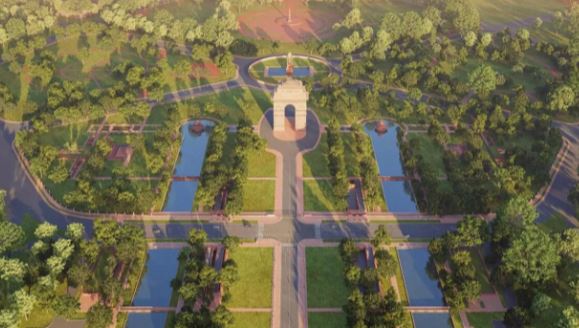
The iconic Central Vista stretch has seen monumental changes since it came into being over nine decades ago, after the birth of New Delhi as India’s capital city.
The avenue continued to be the centre of political and administrative power after Independence, even as it was renamed Rajpath, from Kingsway. The lawns and fountains along the stretch also became one of the most popular public spaces in the Capital.
On December 12, 1911, at the Delhi Durbar, King George V announced the shifting of British India’s capital from Calcutta to Delhi.
On December 15, George V and Queen Mary laid the foundation stone for the new capital at the Durbar Grounds (Coronation Park), following which a comprehensive study of various potential sites for the Capital was undertaken, according to the book New Delhi: Making of a Capital.
Over the next two decades, architects Edwin Lutyens and Herbert Baker carved out the new capital, the book said.
The town planning committee settled upon an area that lay to the south of Shahjahanabad -- Raisina Hill, which was selected as the spot for the new centre of power. While not developed, this area of land had an important elevation through which one could view the previous cities of Delhi, writes historian Swapna Liddle in her book Connaught Place And The Making of New Delhi.
“Looking eastward and starting from the left, one could see Shahjahanabad, fourteenth-century Ferozabad, Purana Qila, and further to the right, the tomb of the emperor Humayun and the Sufi shrine of Nizamuddin. This was a site that could connect the new capital to the imperial past of India,” according to Liddle’s book.
Liddle said the stretch was named Kingsway either after George V or in a generic reference that could apply to future monarchs.
“The name Kingsway was probably meant to be named after George V since the transfer of capital took place during his time, the city was built and finally inaugurated. It’s also possible that a generic name was given so that it could apply to successive monarchs,” said Liddle.
According to historians, the earliest mentions of Rajpath can be traced to maps in the late 1950s.
Historian and author Narayani Gupta, in her article Kingsway to Rajpath: The Democratisation of Lutyens’ Central Vista, says the change in nomenclature from Kingsway to Rajpath was an act of appropriation and democratisation by Independent India.
Over the years, as the city evolved, important workplaces, government offices, and commercial establishments have come up along the Vista. With the New Delhi Municipal Council unanimously approving the renaming of Rajpath to Kartayva Path, the avenue around which the capital city grew has got another name. This week, as the redeveloped Central Vista reopens, another chapter will be added to the Capital’s history.
(With inputs from agencies)