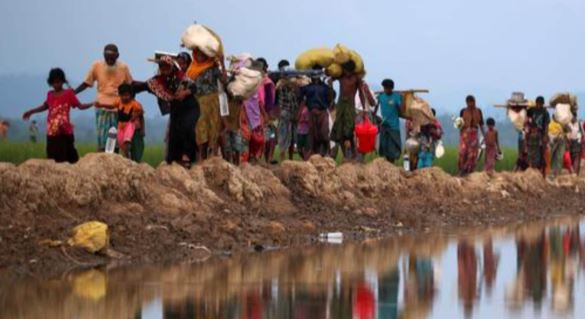
In what the intelligence sources termed “a classic example of community policing”, a local panchayat in Haryana’s Manesar forced at least 500 Rohingya families to vacate their colony overnight, leaving their belongings behind.
The locals alleged that there was a rise in criminal activities in the area after the group settled there.
After deliberations, a mahapanchayat was called by Devender Singh, where it was decided that the inhabitants should show their valid residency documents or vacate the place.
“We later discovered that this was a result of the pressure of the locals. It is a classic example of community policing. We are identifying these Rohingya and will locate their next settlement,” said intelligence sources exclusively told to a news channel.
By some accounts, the Rohingya are descendants of Arab, Turkish or Mongol traders and soldiers who in the 15th century migrated to Rakhine state, previously called the Kingdom of Arakan.
Other historians say they migrated from Bangladesh in several waves, a widely held view among many in Myanmar. For centuries the small Muslim minority lived peacefully alongside Buddhists in the independent kingdom, with some even advising Buddhist royals, according to historians.
Upheaval ensued from the late 18th century as the kingdom was conquered by the Burmese and later by the British. The British favoured Muslims, recruiting them as soldiers during World War II and pitting them against Buddhists aligned with the Japanese as the conflict raged on Burmese soil.
While their status was fortified in 1947 when a new constitution was drafted — giving them full legal and voting rights — it was a brief reprieve.\
A military coup in 1962 ushered in a new era of repression, and a 1982 law stripped them of their recognised ethnic minority group status.
Most lived in Rakhine — but were denied citizenship and harassed by movement and work restrictions.
Hundreds of thousands fled to Bangladesh in successive waves of violence in 1978 and 1991-2.
Using a dialect similar to that spoken in Chittagong in southeast Bangladesh, the Rohingya are loathed by many in Myanmar, who see them as illegal immigrants and call them “Bengali”.
After the junta was dissolved in 2011, the country saw a rise in Buddhist extremism which further sidelined the Rohingya and marked the beginning of the latest era of tensions.
Sectarian violence between the Sunni Muslim Rohingya and local Buddhist communities broke out in 2012, leaving more than 100 dead and the state segregated along religious lines.
Tens of thousands fled over the following five years to Bangladesh and Southeast Asia, braving perilous sea journeys controlled by brutal trafficking gangs.
Despite decades of persecution, the Rohingya had largely eschewed violence.
But in 2016 a small and previously unknown militant group — the Arakan Rohingya Salvation Army (ARSA) — staged a series of well-coordinated and deadly attacks on security forces.
Myanmar’s military responded with a massive security crackdown.
An estimated 391,000 Rohingya fled to Bangladesh in 2017, according to the United Nations, bringing with them harrowing stories of murder, rape and arson.
(With inputs from agencies)