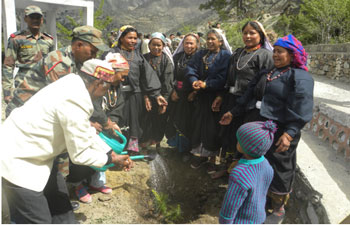
DEHRADUN: The 127 Eco Task Force Battalion of the Territorial Army (TA) has a unique plan to stop migration from the sensitive border areas of Uttarakhand. Conditions in the border region, especially Malarai which remains snow bound from December to April, are very harsh. During this period, locals shift to Joshimath, Chamoli and Gupteshwar.
The migration (palayan as the locals call it) is not confined to the hills of Uttarakhand. In fact, is a nagging issue faced by the governments of all hill states of India.
A void in the sensitive border areas of the nation is inimical to national security. This void creates space for anti-national forces to operate as happened in the case of Kargil.
The nation must also generate revenue, and update its revenue records, as also, the writ of the Central government must run right up to the borders, which is assured when the area is populated.
It, therefore, becomes mandatory to ensure that palayan is controlled. Accordingly, Gen Bipin Rawat, Chief of the Army Staff, tasked Maj Gen D A Chaturvedi, Additional Director General TA to find a unique solution to ensure that Palayan is restricted.
The Eco Task Force, in a unique gesture, gifted high yielding Walnut (Akhrot), trees and Chilgozas, saplings to each villager. These trees will ensure good revenue generation in cash for the villagers in eight to ten years’ time, giving them some incentive to return to their respective roots.
The Eco Task Force has specially got these trees and technical knowhow from Himachal state for the Chilgozas trees. Each tree is planted at a distance of 40 feet, and each family has been gifted two trees. Seeing the popularity of the scheme and the response, Maj Gen Chaturvedi decided to give extra trees to all the families assembled there, thus increasing their revenue generation capacity in the years to come.
A total of 1,00,000 trees will be planted in just two years. The method and the modus operandi are unique; it requires time and patience but also shows that if there is a will there is a way.
The area gets regenerated and plants are being procured from the best sources initially from Himachal and Jammu and Kashmir. It’s the gestation period of ten years which is a little too long, but as the old saying goes, better late than never.
(The writer is a retired Army Brigadier)