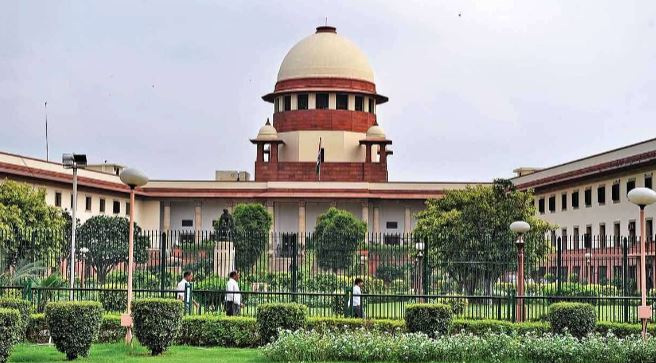
The Supreme Court on Thursday paved the way for declaration of the National Eligibility Entrance Test (NEET) results for admission to medical courses after it stayed an order of the Bombay High Court requiring the National Testing Agency (NTA), the agency which conducts NEET, to hold the re-examination for two students on account of a mix-up of test booklets.
“We cannot delay the results for 16 lakh students,” said a bench of justices L Nageswar Rao, Sanjiv Khanna and BR Gavai while issuing notice to the two students on an appeal filed by NTA challenging the Bombay high court order of October 20.
Further, the bench said, “There shall be stay of the impugned order passed by the high court, until further orders.”
Two students, Vaishnavi Vijay Bhopale and Abhishek Shivaji Kapse, who appeared for NEET on September 12, filed a petition before the Bombay high court complaining that they got little time to write the examination due to a mistake by the invigilator who dropped the test booklets leading to a mismatch of OMR sheet and test booklets of six students. Of them, two went to the high court demanding a re-examination.
The high court directed NTA to hold a fresh examination for the two petitioners and declare the result within two weeks. One of the prayers in the petition filed by the two students required their results to be declared along with the final result of 16 lakh students. The high court gave full effect to this prayer making it absolute. As a result, the direction to hold exams for the two candidates came in the way of the final NEET results announcement.
Solicitor general Tushar Mehta, appearing for NTA along with advocate Rupesh Kumar, informed the court that the two students answered 130 and 160 questions out of a total of 180 questions while the other four candidates attempted all answers. “The four students have not complained of any disadvantage. After we found the mistake, we agreed to rectify it by accepting the mismatch as it is without disqualifying them.”
The argument weighed with the court as it observed, “The question papers fell down for all six students. How can you (petitioners in high court) be differently placed as the other four have completed all questions.”
Advocate Pooja Thorat, appearing for the two students, said the mismatch was pointed out only by the two candidates and not the other four. “After we pointed out the mistake and said this could result in rejection of our examination sheet, the confusion remained for over two hours into the examination and we had to complete the paper in haste,” Thorat said.
The bench told Thorat, “You are not taking into account lakhs of students who are waiting for their results. Whatever confusion is there, the NTA is ready to rectify. They are ready to go by what you have answered.”
Abhishek Kapase, one of the two Solapur students to have approached the high court, said the Supreme Court’s verdict might be fair to lakhs of the other aspirants, but they had been penalised.
“I have attempted the exam with all my knowledge, but due to the error on part of the invigilator, my answers do not match the question paper so I have been marked zero in the exam. None of this is our fault but the judiciary has punished us in this bargain,” Kapase, 19, said.
The court posted the matter on November 12 and asked NTA to come out with a plan for the two students. It suggested to Mehta to consider the number of questions answered by the two candidates as 180 and award marks accordingly. Mehta agreed to come back with instructions.
In its appeal before the top court, NTA complained that the effect of the high court order is that the petitioner (NTA) who has conducted the NEET (UG) 2021 examination for more than 16 lakh candidates on September 12 is not able to declare their results even though the same is ready for declaration. The delay in declaration of result of NEET (UG) 2021 will affect and further delay the subsequent process of admission to undergraduate medical courses.”
The NTA filed an affidavit in the high court accepting the mistake of the invigilators. The high court relied on this fact to ensure that the students do not end up paying the price for the mistake by invigilators. Although the high court held that its order shall not be treated as a precedent, NTA apprehended that for future, similar incidents could lead to cases in courts by students demanding re-examination.
(With inputs from agencies)