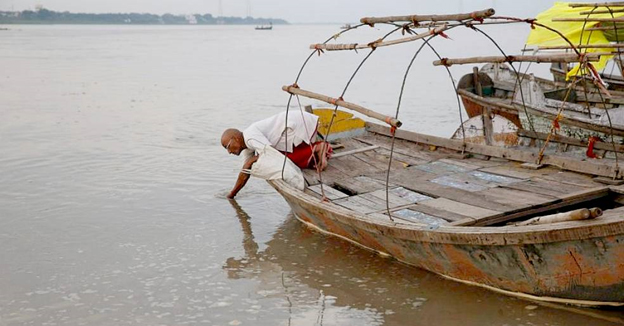
New Delhi: A Uttar Pradesh Pollution Control Board official said that sixty one per cent of Ganga water samples collected from 15 districts of Uttar Pradesh failed to pass a quality test. They were marked as unsatisfactory by the Uttar Pradesh Pollution Control Board (UPPCB).
The results of the 31 samples of Ganga water out of which 19 failed to pass the quality test underlines the uphill struggle that the National Mission for Clean Ganga — India’s most ambitious attempt to clean the country’s holiest river — faces.
The report for August revealed the level of faecal coliform and total coliform bacteria was more than the maximum permissible limit of 2,500 most probable number (MPN) per 100 ml of water which makes it unsafe for drinking. The desirable level is 500 MPN/100 ml.
“Abnormally high level of both forms of bacteria in Ganga was largely due to discharge of untreated sewage water into the river,” said regional officer, UPPCB, Allahabad SK Mishra,
The report said count of faecal coliform bacteria in water samples of Ganga collected from six different spots in Kanpur district was found to be more than permissible limit.
Against the maximum limit of 2,500 MPN per 100 ml of water, the bacteria count was found to be 58,000 in downstream Kanpur; 7,800 at bathing ghat under Jajmau bridge; 3,200 in Shukla Ganj, 3,100 each in Bhairav Ghat and Gola Ghat besides 2,700 in upstream Kanpur.
Further, the fecal bacteria count was measured at 31,000 in downstream Varanasi, 22,000 at downstream Tarighat in Ghazipur, 13,000 at Saidpur in Ghazipur, 51,00 in Dalmau, Rae Bareli, 4,900 in Kalakakar, Pratapgarh and 3,100 at Kadaghat in Kaushambi besides downstream in Kannauj.
Similarly, the count of total coliform bacteria in Ganga was also found at a staggering 1,10,000 in downstream Kanpur, followed by 46,000 in downstream, Varanasi; 34,000 in downstream Tarighat; 23,000 in Saidpur, Ghazipur; 14,000 at bathing ghat under Jajmau bridge in Kanpur; 9,200 in downstream, Allahabad; 7,900 in upstream, Allahabad.