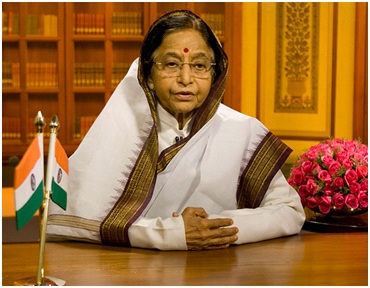
New Delhi: Pratibha Devisingh Patil, the 12th President of India and the first woman to hold the office, was born on December 19, 1934, at Nadgaon village in Maharashtra’s Jalgaon district.
Patil was elected to the Maharashtra Legislative Assembly on a Congress ticket in 1962 and consistently won the state elections between 1967 and 1985.
She became a Rajya Sabha member in 1985 and was elected to the Lok Sabha in the 1991 general elections from Amravati constituency. On November 8, 2004, Patil became the Governor of Rajasthan, the first woman to occupy the post.
Three years later she emerged as a compromise candidate for President and her name was announced by the Congress-led United Progressive Alliance on June 14, 2007. She won the election against Bhairon Singh Shekhawat, backed by the opposition National Democratic Alliance.
Tenure as president
According to a BBC profile, Patil “was by no means a unanimous choice for the role”. But her long association with the Gandhi family made the “low-profile governor” of Rajasthan the “favoured presidential candidate of Sonia Gandhi”.
When asked about her decision to keep her maiden name after she got married, Patil said: “I had contested elections [in Maharashtra] before I got married — people knew me as Pratibha Patil. So I kept the name. People accepted it — my husband accepted it.”
Her term was free of the kinds of friction that erupted during the tenures of some past Presidents that led Rashtrapati Bhavan towards collision with the political executive.
She also quietly used her office to focus attention on the crisis in India's countryside, a crisis that has claimed thousands of lives in Maharashtra, a State that she has decades-old ties of kinship and social engagement with.
On the other hand critics described her as “just another loyalist Congressperson who did exactly what her government asked her to do”.
In her last Republic Day speech as President, Patil told the nation that there seemed to be a tendency in the country to doubt almost everything. “Do we not have faith in our own people’s strengths and in our institutions? Can we afford distrust amongst ourselves?” the President said.
“Nations are built through great patience and sacrifices. Concord and not discord is the way forward for a country as large as India. Negativity and rejection cannot be the path for a vibrant country that is moving to seek its destiny.”
However unlike former President Kalam, a space scientist who was popularly known as the “People’s President” as he bridged the gap between high office and the masses, Ms. Patil was not much of a public persona.
Special events and controversies
President of India Pratibha Patil was the second president to fly in a Sukhoi when she flew in the fighter jet Sukhoi 30 MKI (SB 139) in Pune. Her pilot for the flight was Wing Commander S. Sajan.
She flew at a speed of more than 800 kmph at a height of 2.2 km over Rajgurunagar, Shirur, Baramati and Pune parts of the district. The jet plane carrying the President was accompanied by two other Sukhoi planes which flew in a formation with her aircraft.
Her predecessor Dr. A.P.J. Abdul Kalam flew at a height of 20,000 feet at subsonic levels with some air manoeuvres in 2006.
She commuted the death sentences of 35 petitioners to life, a record. The presidential office, however, defended this by saying that the President had granted clemency to the petitioners after due consideration and examining the advice of the Home Ministry.
Patil was noted for having spent more money on foreign trips, and having taken a greater number of foreign trips, than any prior president.
Sometimes accompanied by as many as 11 members of her family, there had been 12 foreign trips spanning 22 countries by May 2012, when she was away on her 13th trip. Those completed travels had cost Rs 205 crore (2.05 billion).
Patil allegedly used public funds to build a retirement mansion on a 260,000 square feet (24,000 m2) plot of military land in Pune. Tradition is that a retiring president either takes residence in government accommodation in Delhi or moves back to their residence in their home state; her use of government money to build a retirement home at the end of the presidential term was unprecedented.
Other controversies that arose after her retirement included her desire to claim both an official government car and fuel allowance for the running of a private car, despite rules clearly stipulating that this was an either/or situation. She also took possession of many gifts that had been given to her in her official role and was later forced to return them.
References
https://en.wikipedia.org
www.mapsofindia.com
www.thehindu.com
https://blogs.wsj.com