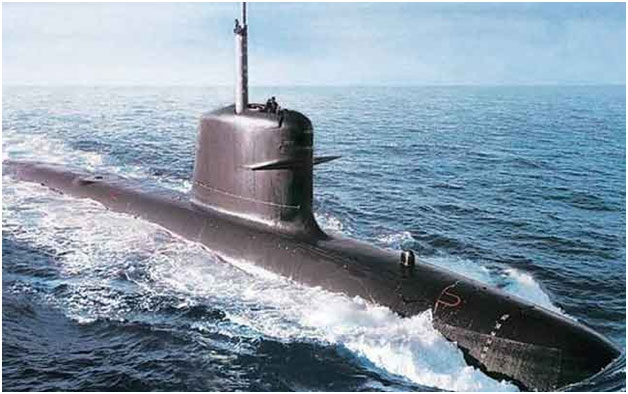
New Delhi: Prime Minister NarendraModi will commission India's first new diesel-electric submarine in over 17 years in Mumbai today.
The new 1,565-tonne submarine, named INS Kalvari (tiger shark, a deadly deep-sea predator) will be commissioned after the first-ever submarine inducted by India from Russia in December 1967. It is to be followed by five of her Scorpene sisters under the Rs 23,652 crore "Project-75" underway at Mazagon Docks in collaboration with France.
The Scorpene project, of course, has faced huge time and cost overruns after the contract with French shipbuilder DCNS (the Naval Group) was inked way back in October 2005.
INS Kalvari, for instance, was to be ready by 2012, with the other five coming by 2017. Now, the second one INS Khanderi will be commissioned by mid-2018, with the third INS Karanj following by early-2019. All the six will be inducted by 2020-2021 now.
The Navy is also keen to kick-start the long-delayed "Project-75-India" for construction of six new stealth submarines, with both land-attack missile capabilities and air-independent propulsion for greater underwater endurance. "We hopeful of beginning the project by end-2018," said Navy chief Admiral Sunil Lanba.
Four global ship-builders — Naval Group-DCNS (France), ThyssenKrupp Marine Systems (Germany), Rosoboronexport Rubin Design Bureau (Russia) and Saab Kockums (Sweden) — have responded to the initial RFI (request for information) issued by the Navy for this project estimated to be over Rs 60,000 crore.
Under P-75I, which was accorded "acceptance of necessity" in November 2007, a foreign collaborator will be selected to tie-up with a domestic shipyard under the "strategic partnership" policy. It will take seven to eight years after the contract is inked for the first submarine to roll out.
India needs at least 18 diesel-electric and six nuclear attack submarines, backed by four SSBNs armed with long-range ballistic missiles, to guard against the two-front threat scenario from China and Pakistan as well as achieve credible nuclear deterrence.