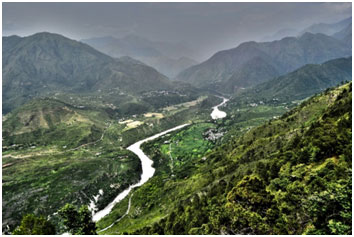
New Delhi: The Saraswati River is one of the main Rig vedic rivers mentioned in ancient Sanskrit texts as one of the most sacred of Indian rivers.
Now modern scientist have come out with new evidence that say that the Indus valley civilization which supposedly grew along the banks of the river Saraswati may actually have been on a tributary of the river Sutlej and furthermore the Saraswati itself may have been a seasonal river.
The findings derived from new geological evidence gathered by the international team of scientists led by Sanjeev Gupta, a geologist with Imperial College London, shed new light on how the Indus Valley civilization grew and died.
Mythological location of the river Saraswati
The first reference to the disappearance of the lower course of the Sarasvati is from the Brahmanas, texts that are composed in Vedic Sanskrit, but dating to a later date than the Veda Samhitas.
According to the Mahabharata, the Saraswati dried up to a desert (at a place named Vinasana or Adarsana) and joins the sea "impetuously". The desert made when Saraswati dried up was the Thardesert.
Also, a journey was made during the Mahabharata by Balrama along the banks of the Saraswati from Dwarka to Mathura. There were ancient kingdoms too that lay in parts of north Rajasthan and that were named on the Saraswati River.
In the Manu Smriti, the sage Manu, escaping from a flood, founded the Vedic culture between the Sarasvati and Drishadvati rivers.
One can clearly see that there exist a wealth of geographical references in Hindu mythology to the existence of a river that once sustained a large civilization.
Relation of the river to the Indus Valley Civilization
The scientists reported in the journal Nature Communications that there existed a river in that area more than 8000 years ago. However the most recent archaeological surveys peg the Indus valley civilization at only 4500-5000 years ago.
Through meticulously carried out sediment studies and remote sensing, the scientists identified that the present-day Ghaggar river (it is called Hakra in Pakistan), which is a seasonal river, flows through this former course of Sutlej.
“But our detailed dating of the river sediments show that the river was not flowing there at the time of the Indus settlements -- the Sutlej had diverted several thousand years before the development of the urban Indus civilisation,” said Gupta.
The study calls into question the contention of a section of archaeologists that these ancient urban settlements might have developed along the “lost” river of Saraswati..
“Many believed that it was the death of a river that led to the collapse of the civilisation. But what we find is that it was the demise of a river (by changing of its course) that helped a civilisation to come up and flourish,” said Rajiv Sinha, a professor of earth sciences at IIT Kanpur, who contributed to the study.
Poetical belief in Full flow
Some studies suggest that the Yamuna and Sutlej were lost during the Pleistocene, and that the Saraswati was a much smaller river, fed entirely by monsoon rains rather than glacial streams.
Recent Hindu belief is that still Saraswati river flows underground and meets Yamuna and Ganga at their confluence in Prayag (Allahabad).
In usual stories and kathas, you will hear that they compare the Saraswati river to the hidden 3rd part of the veni. The braid has three parts of which only two are visible. So, like the hidden part, Saraswati always flows underground while Ganga and Yamuna flows visibly above the ground.
Whatever be the case, it is still worth finding out if the Indus Valley civilization is the culture being talked about in the Hindu scriptures through more scientific geological and archaeological studies.
References
www.speakingtree.in
www.wikipedia.org
www.thehindubusinessline.com