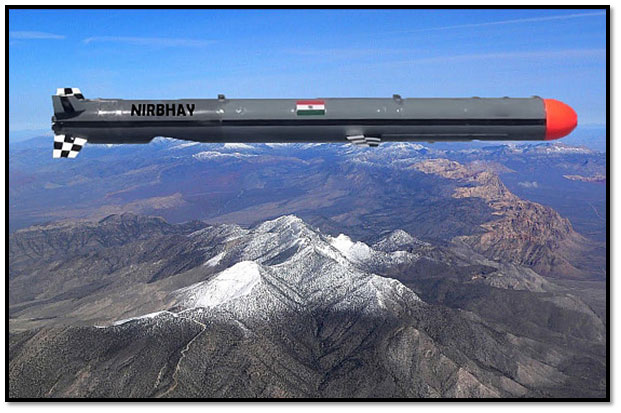
New Delhi: The Nirbhay missile was successfully testfiredon Tuesday, November 7 by the Defense Research and Development Organization (DRDO) at 11:20 am, from Integrated Test Range (ITR) at Chandipur in Odisha'sBalasore.
It is India’s first indigenously designed and developed long range sub-sonic cruise missile.Minister NirmalaSitharaman from the Ministry of Defense has "hailed the success of DRDO." And said, the missile took-off as programmed and "majestically cruised" for a duration of 50 minutes at a range of 647-km.
About NirbhayMissile’:
Comparable with America's Tomahawk missile as far as the stealth capability, the Nirbhay is meant to fly at a range of around 1,000km at a speed between 0.8 and 0.9 Mach. With a diameter of 0.52 m and wing span of 2.7 m, it weighs around 1,500 kg and can carry warheads up to 200 kg.
Reportedly, the Nirbhay can carry 24 different types of conventional or nuclear warheads.
FeaturesOfIndia's ‘FearlessMissile’:
The missile's guidance, control and navigation system is configured around the indigenously designed Ring Laser Gyroscope (RLG) and MEMS based Inertial Navigation System (INS) along with GPS system. It was guided by a highly advanced inertial navigation system indigenously developed by Research Centre Imarat (RCI).
The missile has a fire-and-forget system that cannot be jammed.
It has blended missile and aeronautical technologies which allows it to take off vertically like a missile and cruise horizontally like an aircraft.
It is a two stage missile. In its first stage, it tilts horizontally. In the second stage it will cruise horizontally like an aircraft with a turbo-jet engine at a subsonic speed of 0.7 Mach. It is capable of carrying multiple payloads including nuclear warheads.
It is capable to engage several targets in a single flight. It can be launched from various kinds of platforms, ranging from surface lorry to a ship, from air and even from underwater vessels.
It is a terrain hugging missile which keeps on encircling the area of its target for several minutes and then hits bull’s eye’ on an opportune time.
It is expected to supplement the India-Russian joint venture BrahMos supersonic cruise missile which can carry warheads up to 290 km.
Cruise MissilesAnd Their Capabilities:
Cruise missiles fly at a low altitude, mostly to avoid radar detection, and can be guided throughout its path. They fly within the earth's atmosphere and use jet engine technology. These vehicles vary greatly in their speed and ability to penetrate defences.
Therefore,cruise missiles such as the Nirbhay offer the longer ranges of ballistic missiles but are cheaper and more mobile.Their smaller sizes mean they can be launched from land, air-borne bombers, warships and even submarines.
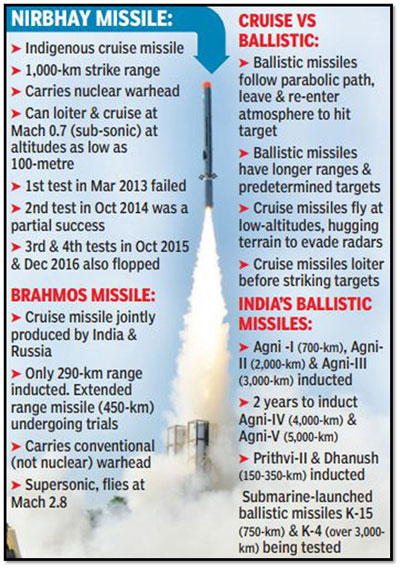
It is a sub-sonic cruise missile. It blasts off like a rocket, but then unlike a missile, it turns into an aircraft. Unlike other ballistic missiles like the Agni, which follow a parabolic trajectory, leaving and re-entering the earth's atmosphere before hitting their targets;Cruise missiles like Nirbhay, in turn, has wings and pronounced tail fins. It is designed to fly at low-altitudes, almost hugging the terrain, to evade enemy radars and missile defence systems.
Why The NirbhayCruise Missile Matters For India?
The development is significant because the armed forces have long been demanding nuclear land-attack cruise missiles (LACMs), with ranges over 1,000-km and versatile enough to be fired from land, air and sea.
The Nirbhay missile is crucial for India especially because Pakistan has already developed the 700-km Babur cruise missile.
The Nirbhay is very manoeuvrable and can fly at tree-top level making it difficult to detect on radar.
Once near the target, it can even hover, striking at will from any direction. And once inducted, the Nirbhay missile would allow India to launch attacks deep into Pakistan and China without the risks of losing any manned assets.
It can strike targets more than 700 km away carrying nuclear warheads, giving India the capability to strike deep into enemy territory. As per its stated range, the Nirbhay is capable of targeting the Pakistani cities of Lahore, Islamabad, Peshawar, Rawalpindi, and Karachi.
It gives India the capacity to launch different kinds of payloads at different ranges from various platforms at a very low cost. It can be launched from a mobile launcher.
It is India's answer to America's Tomahawk and Pakistan's Babur missile. The UShad deployed cruise missiles very effectively during the Gulf War.
India has made ballistic missile and tactical missiles of different capacity, but was yet to master the making of a cruise missile.
But often brandished as India's answer to the famed American Tomahawk missiles, as also an effective counter to Pakistan's Babur LACM, the Nirbhay had been in the making for a decade without much success till now.
The Road So Far:
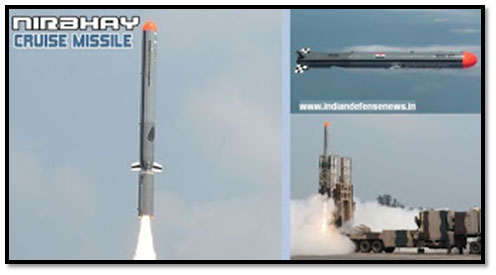
The missile was developed by the Aeronautical Development Establishment (ADE), Bengaluru. After the design was finalized, the technology required for the missile was developed. It was integrated by R&D Engineers, Pune, a specialized arm of DRDO.
Launched by the DRDO in 2004, Nirbhay missile was expected to be completed by 2016. Unlike BrahMos, Nirbhay was intended to be a sub-sonic cruise missile with a range of over 1000 kms and capable of carrying around 300 kilograms of warhead with a reaching speeds of 0.6-0.7 Mach.
It is designed to be launched from air, sea, and land but, ever since its conceptualisation, Nirbhay's test results have not yielded results that were expected:
The Nirbhay's maiden test, held in March 2013:
The first trial of Nirbhay was held on March 12, 2013 from the Integrated Test Range at Chandipur. Missile took off from the launch pad successfully and reached the second stage of propulsion, travelling 15 minutes through its envisaged path at a speed of 0.7 mach. After that it veered away from its trajectory. This forced the command centre to detach the engine from the missile mid-way into the flight.
The test was a partial success as the missile took off, reached the second stage of propulsion, and travelled 30% of its range before deviating from its path.
The Nirbhay's Second test In October 2014:
The second test of Nirbhay was held on October 17, 2014, from Chandipur. This time the missile met all the parameters and completed all 15 way-points. The missile travelled for more than 1000 km that lasted for duration of over 1 hour and 10 minutes. Indian Air force fighter jet Jaguar chased the missile during its flight to capture the video of the flight.
The Nirbhay's Third test, held in October 2015:
During its third test on October 16, 2015, all initial critical operations were successful and Nirbhay even and the missile even reached the desired Cruise Altitude. But, it crashed into the Bay of Bengal 11 minutes into its flight after covering only 128 km of its 1000 km range.
The Nirbhay's fifth test, held in October 2016:
Nirbhay's fourth test took place on December 21, 2016, from ITR Chandipur. The results of this test have not been made public yet. Reports say that the missile blasted off from its launcher but shortly afterwards it started veering dangerously towards one side two minutes after lift-off. The missile then had to be destroyed mid-air after it strayed from its programmed course. Potential reason for the failure was described as a hardware problem with one of the missile's component.
This way, after back-to-back failures, India successfully conducted a flight test of the indigenous subsonic Nirbhay cruise missile. Long range nuclear-capable subsonic cruise missile Nirbhay,is consideredas the most crucial land-based weapon system currently under development in India.
References:
https://www.ndtv.com
https://www.newsbytesapp.com
http://newburghgazette.com
https://www.oneindia.com