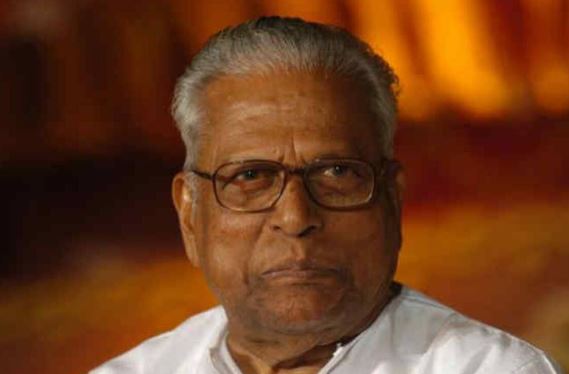
As enthusiasm surrounding the upcoming assembly elections in Kerala reaches its peak, a prominent figure missing from the campaigning phase is Velikkakath Sankaran Achuthanandan, one of the tallest communist leaders in the country.
In the southern state, the 97-year-old leader, who hails from the communist bastion of Alappuzha, has had a key role to play in elections over the past seven decades. And what made his rallies popular were sharp and witty one-liners and thundering political denunciations of opponents.
After the 2016 assembly elections — in which the Left Democratic Front (LDF) returned to power — he took a political back seat.
A seven-time legislator, Achuthanandan, or VS (as he is popularly called), resigned as the chairman of the state Administrative Reforms Commission in January-end, sparking speculations that he was retiring from politics.
In a statement, he cited his poor health and “strict regimen as per advice of the doctors following a brain haemorrhage”. Achuthanandan had held the post at the body tasked with reviewing the functioning of the state’s administrative machinery since 2016, after Pinarayi Vijayan was made the Chief Minister (CM).
Achuthanandan still holds the Malampuzha assembly seat that he has been winning since 2001.
Such was Achuthanandan’s political clout and ability to draw crowds that Communist Party of India (Marxist), or CPI (M), general secretary Sitaram Yechury once described him as “the warhorse that led the election campaign from the front”.
“However, considering his old age and physical ailments, his services cannot be utilised for the Chief Minister’s chair. The party considers him as the ‘Fidel Castro of India’, and like Castro, he will take the lead role in advising the state government leadership on governance and policy,” Yechury said, announcing 72-year-old Vijayan as the CM after the LDF won 91 of the state’s 140 seats in 2016.
However, mere parallels with the legendary Cuban revolutionary at the cost of chief ministership did not go down well with his backers. In the run-up to the 2016 voting, he was a star campaigner in the Left camp with several legislators requesting his service to bolster their chances.
Achuthanandan’s political journey was marked by several ups and downs. One of his finest moments came when the national leadership of the Communist Party of India (back then it was undivided) entrusted him with the charge of handling the campaign for the crucial Devikulam by-election in 1958.
Achuthanandan, then district secretary of the party in Alappuzha, was chosen by the central leadership in what was a do-or-die situation for the state’s first elected communist government, which was surviving on a wafer-thin margin.
Though there were several heavyweights around, Achuthanandan, who quit studies after Class 7, was picked for the critical task. After all, it was Achuthanandan who was instrumental in sending the maximum number of party MLAs from a district to the assembly in the 1957 elections. Out of the 14 assembly seats in Alappuzha, communists won nine. An independent legislator too extended support to the party.
Finally, in the crucial by-election, Achuthanandan’s strategy made Rosamma Punnoose raise her victory margin from 1,922 votes a year ago to 7,089.
Achuthanandan was elected a Member of the Legislative Assembly (MLA) in 1967 from Ambalappuzha in Alappuzha district. He went on to represent the seat till 1977. He was the state secretary of the CPI(M) from 1980 to 1992, and the leader of the opposition in the Kerala assembly on three occasions: 1991-1996, 2001-2006 and 2011-2016.
According to party insiders, it was at the insistence of Achuthanandan that the LDF went to elections in 1991, when the communist government still had a year to complete its tenure. The government had gained goodwill, it was perceived, and the preceding district council elections gave an upper hand to the Left.
Achuthanandan was a natural choice to lead the next government if the LDF came to power. But eventually, the LDF had to sit in opposition after the elections, which coincided with the Lok Sabha polls in the aftermath of the killing of then Prime Minister Rajiv Gandhi. For Achuthanandan, it was a shock defeat at the hands of the Congress-led United Democratic Front (UDF). In 1996, he suffered another loss in the coastal seat of Mararikulam, though the LDF came back to power that year.
He became the LDF convener later, and it was another turning point in his political career. He started taking up popular issues, including environmental concerns and crimes against women. In a way, he metamorphosed from a rigid communist leader to a darling of the masses.
It was this popularity that forced the CPI(M) to go back on its original decision to deny him a ticket in the 2006 elections. The change of mind was swift. It came within a couple of days after the initial announcement. After the results, Achuthanandan finally became the CM, winning from Malampuzha in Palakkad district that has remained his turf since 2001.
In the 2011 elections, he almost created history as an incumbent in Kerala’s politics, where governments usually change every five years. But Oommen Chandy-led UDF scraped through, winning by a margin of just two seats.
(With inputs from agencies)