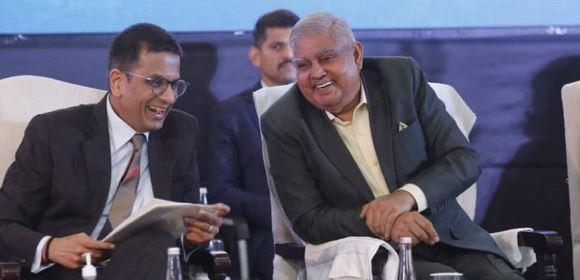
In an oblique reference to the Supreme Court’s 2015 judgement striking down the National Judicial Appointments Commission Act, 2014, which sought to overturn the Collegium system of appointments in the higher judiciary, Vice-President Jagdeep Dhankhar, sharing the dais with Chief Justice of India D Y Chandrachud, said Friday it was “never too late to reflect”.
Underlining the “primacy of the will of the people”, Dhankhar, who was addressing a gathering at the 8th Dr L M Singhvi Memorial Lecture in New Delhi, said “that power was undone” and “the world does not know of any such instance”.
His remarks come days after Union Law Minister Kiren Rijiju questioned the Collegium system of judicial appointments, calling it “opaque” and “alien”. The Minister’s remarks attracted the displeasure of the Supreme Court earlier this week.
Speaking after CJI Chandrachud delivered the lecture on the topic of universal adult franchise, the Vice-President said, “The Indian Parliament, in 2015-216, was dealing with a Constitutional amendment Act and, as a matter of record, the entire Lok Sabha voted unanimously. There was no abstention and no dissension. And the amendment was passed. In Rajya Sabha, it was unanimous, there was one abstention. We, the people – their ordainment was converted into a constitutional provision. The power of the people came to be reflected… on a legitimate platform through applicable mechanisms. That power was undone. The world does not know of any such instance.”
The Constitution (Ninety-Ninth Amendment) Act, which established the National Judicial Appointments Commission, and the NJAC Act were passed by Parliament in 2014 to set up a commission for appointing judges, replacing the Collegium system. The Collegium evolved through the Supreme Court ruling in the Second Judges Case in 1993 and its opinion on a Presidential reference in 1998 in what came to be known as the Third Judges Case.
The laws were repealed in October 2015, after the Supreme Court struck them down.
Dhankhar said, “If a Constitutional provision that carries the ordainment of people at large in such a vibrant democracy is undone, what will happen? I am appealing to everyone that these are the issues that should not be viewed on partisan lines.”
(With inputs from agencies)